

The Health Benefits of Kefir — A Fermented Drink Worth Adding to Your Daily Routine
If you’ve never tried kefir, it’s one of those things that sounds a bit unusual until you actually start making and drinking it — and then it quickly becomes something you wonder how you did without.
I make kefir regularly at home, and it’s become one of my favourite fermented foods. It’s simple, versatile, and genuinely good for you in ways that go well beyond a standard probiotic supplement.
As always, I’m not a doctor and this isn’t medical advice. What I’m sharing here is what I’ve learned through my own research and experience. If you have specific health concerns, please talk to a qualified professional before making changes to your diet.

What Is Kefir?
Kefir is a fermented drink traditionally made from milk, though water kefir is a popular dairy-free alternative. It’s made using kefir grains — not actual grains like wheat or oats, but small, gelatinous clusters of bacteria and yeast that ferment the milk over 24 to 48 hours.
The result is a tangy, slightly fizzy drink with a consistency somewhere between milk and thin yogurt. It has a distinct flavour that takes a little getting used to, but most people come to really enjoy it — especially when blended with fruit or used in smoothies.
What makes kefir stand out from other fermented dairy products like yogurt is the sheer variety of beneficial microorganisms it contains. Where yogurt typically contains a handful of bacterial strains, kefir can contain upwards of 30 to 50 different strains of bacteria and yeasts. That diversity is a big part of why it’s so interesting from a gut health perspective.
The Health Benefits of Kefir
A Powerful Source of Probiotics
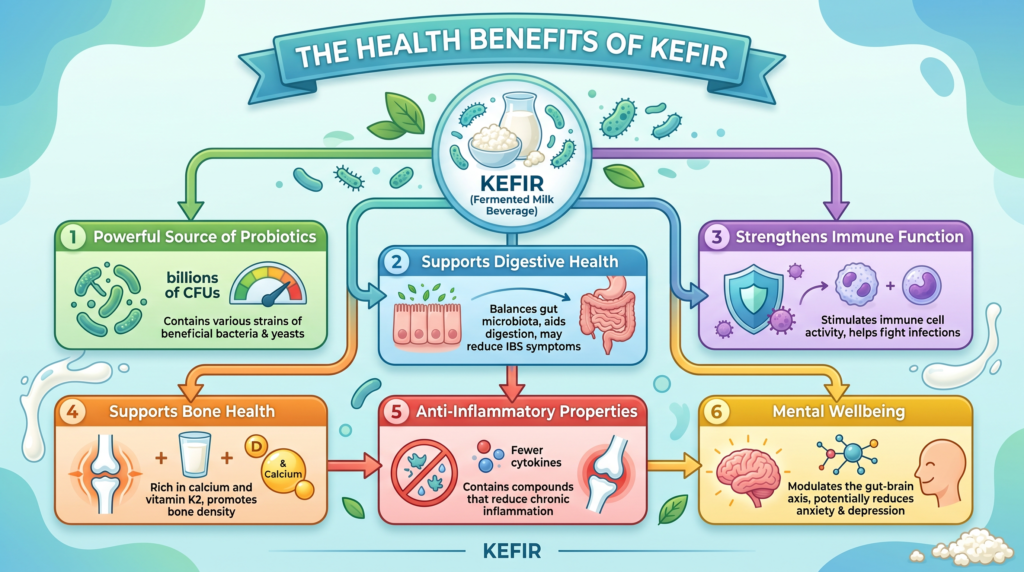
Kefir is one of the richest natural sources of probiotics available. The live bacteria and yeasts it contains help populate and diversify your gut microbiome — and as I’ve written about before on this site, a diverse microbiome is increasingly linked to better health outcomes across the board.
The bacterial strains in kefir include well-researched species like Lactobacillus and Bifidobacterium, as well as beneficial yeasts that you won’t find in most other fermented foods. This combination makes it a genuinely unique addition to your diet.
Supports Digestive Health
This is where most people notice the benefits of kefir first. Regular consumption has been associated with reduced bloating, more comfortable digestion, and better tolerance of dairy in people who are mildly lactose intolerant.
That last point surprises many people. Because the fermentation process breaks down much of the lactose in milk, many people who struggle with regular dairy find they can tolerate kefir quite well. The bacteria in kefir also produce lactase — the enzyme needed to digest lactose — which adds another layer of support.
Strengthens Immune Function
A well-populated gut microbiome plays a central role in immune health, and kefir is one of the most effective fermented foods for supporting that microbiome. Some research has looked specifically at kefir’s potential to support immune responses and reduce the duration of common illnesses, though this is an area where the science is still developing.
What I can say from my own experience is that since making fermented foods — including kefir — a consistent part of my diet, I generally feel more resilient. Whether that’s entirely down to kefir I can’t say for certain, but it’s part of a picture that’s working for me.
May Support Bone Health
Kefir made from full-fat milk is a good source of calcium, vitamin K2, and protein — all of which play important roles in bone health. This is particularly relevant for older adults, where maintaining bone density becomes increasingly important. Some research has looked at whether the combination of probiotics and these nutrients in kefir might offer benefits beyond what calcium alone provides.
At 67, bone health is something I take seriously, and it’s one more reason I’ve made kefir a regular part of my routine.
Anti-Inflammatory Properties
There’s growing interest in the potential of kefir to support healthy inflammation levels in the body. Some studies have looked at how the beneficial compounds produced during kefir fermentation — including certain peptides and organic acids — may influence inflammatory pathways. This is early research, but it fits with the broader picture of fermented foods and gut health being connected to overall inflammation management.
Mental Wellbeing
As with other fermented foods, kefir’s influence on the gut-brain axis is worth mentioning. The gut and brain are in constant communication, and the state of your microbiome can influence mood, stress response, and cognitive function. Some research has specifically looked at probiotic-rich foods like kefir in relation to anxiety and low mood, with encouraging early findings.
Milk Kefir vs Water Kefir
It’s worth briefly explaining the difference because they’re two quite distinct products.
Milk kefir is made with dairy milk and kefir grains. It has a creamy, tangy taste and is the more researched of the two in terms of health benefits.
Water kefir is made with sugar water or coconut water and a different type of grain. It’s dairy-free, lighter in taste, and slightly fizzy — a good option if you don’t consume dairy or simply prefer a lighter drink.
Both are genuinely beneficial and both are straightforward to make at home. Milk kefir tends to be a better source of protein and calcium, while water kefir is more accessible for those avoiding dairy.
Homemade vs Shop-Bought
You can buy kefir in most supermarkets now, which is great for convenience. However, the same caveat applies here as with other fermented foods — commercial kefir is often heat-treated after fermentation to extend shelf life, which reduces the live bacterial count significantly.
Homemade kefir, made with active grains, contains far more live cultures and a greater variety of strains than most commercial versions. It’s also considerably cheaper once you have your grains, since the grains grow and can be reused indefinitely.
I’ll be covering how to make milk kefir at home in an upcoming post — including the equipment you need and where to get good quality grains.
How I Use Kefir
I drink a small glass most days, sometimes plain and sometimes blended with banana and berries as a smoothie. It also works really well as a base for salad dressings, stirred into overnight oats, or used in baking as a substitute for buttermilk.
The key, as with all fermented foods, is consistency. A small amount regularly is far more valuable than a large amount occasionally.
A Few Things to Keep in Mind
Kefir is generally very well tolerated, but if you’re new to fermented foods it’s worth starting with a small amount and building up gradually. Some people experience a little bloating initially as their gut adjusts — this usually settles within a week or two.
If you’re immunocompromised or have a serious underlying health condition, it’s worth checking with your doctor before adding kefir to your diet, as with any significant dietary change.
If you’re already making L. Reuteri yogurt and looking for the next fermented food to add to your routine, kefir is a natural next step. Different strains, different benefits, and a completely different taste experience — it’s a great way to broaden the diversity of your fermented food intake.
Where to Go Next
If you’re improving batches, these help: